CASE STUDY
Neurodiversity Resources for Work-Integrated Learning
5-minute read
5-minute read
Hands-on learning experiences such as internships and field placements are hugely valuable to students preparing to enter the workforce, but are not always set up in a way that supports neurodivergent students. Starting in 2022, the University of Calgary worked with partners to research and improve how programs with these elements operated.

As their initiative entered its final phase, UCalgary brought on Onlea to create a set of digital resources to support post-secondary staff and faculty. The goal was to ensure that neuroinclusivity efforts were not only preserved but would continue to grow and evolve beyond the original project.

“We wanted a legacy project that would continue this learning with new staff members and extend the learning to other campuses.”
— Erin Kaipainen, Director, Student Success and Operations

About the WIL-ND Initiative
Many post-secondary programs include some form of work-integrated learning (WIL), such as a practicum, co-op, or internship. Students in a wide range of disciplines, from nurses and engineers to educators and entrepreneurs, gain valuable work experience and connections with potential future employers.
However, neurodiverse (ND) learners with different ways of thinking, learning, and navigating new environments often face barriers with WIL experiences and struggle to complete them successfully, even with strong competencies and work ethics.
From 2022–2025, UCalgary partnered with the Sinneave Family Foundation and launched the Work-Integrated Learning for Neurodiverse Students initiative (WIL-ND) to explore how to better support these students and improve WIL experiences at UCalgary and beyond.
They made many significant changes, including developing training webinars for partner-employers, creating a practicum navigation guide for students in programs related to disability and rehabilitation, and hosting internal training seminars for staff and faculty involved with facilitating WIL experiences.
Our Challenge
Over the four years, the WIL-ND initiative had been successful in gathering knowledge, building engagement, and making improvements to many work-integrated learning experiences for neurodivergent students at UCalgary.
But now it was time to shift gears.
"We sought to create an open-access resource for postsecondary staff and faculty members... While we had a concept in mind, our capacity to optimize the model and convene key partners was limited."
— Erin Kaipainen, Director, Student Success and Operations
The UCalgary team wanted to ensure that the digital resources they developed would prepare staff and advisors to support students in whatever situations they might encounter.
This would be no easy feat, considering the sheer scope of neurodivergent experiences, combined with variability among the academic programs and the types of workplaces a student might encounter.
Since work-integrated learning is such a valuable opportunity for students, it is offered as an option in many programs at UCalgary, with diverse experiences in areas such as arts, nursing, engineering, business, and education.
Onlea’s role would be to work with WIL-ND initiative leaders to re-engage participants and interest holders, explore what kinds of resources would best fit their needs, and support planning and design for a collection that would be more than just another toolkit — something that would empower staff and faculty across the UCalgary community and beyond.
Our Solution
In collaboration with the WIL team leadership, Onlea facilitators ran a set of carefully structured Breakthrough Labs workshops.
The WIL team leadership focused on making sure the right people were in the room. Participants included members of UCalgary’s Office of Signature Learning Experiences (OSLE), members of faculties that offer work-integrated learning experiences, student accessibility experts, and a student ambassador with lived experience and insights.
During the workshops, Onlea’s facilitators led the participants through conversations about the complex needs and challenges of the faculty and staff specific to their own programs and departments, as well as their vision for resources that could promote meaningful change across institutions.
This combination of in-person and virtual workshops was designed to:
- Map out the network of interests connected to the project,
- Understand the audience for the intended legacy resource, and
- Begin shaping priorities for the resource’s development.
The first workshop provided a rare opportunity for participants from across the university to come together in person, connect over a meal, and share their insights in an open-ended way.
It also gave everyone involved a chance to identify their role on the project and share their relationship to WIL and neuroinclusive education initiatives.
We opened with a set of framing questions about project goals, restraints, gaps, environment, and competing resources. Using whiteboards and sticky notes, Onlea facilitators captured these responses on a large matrix in a modified SWOT analysis.
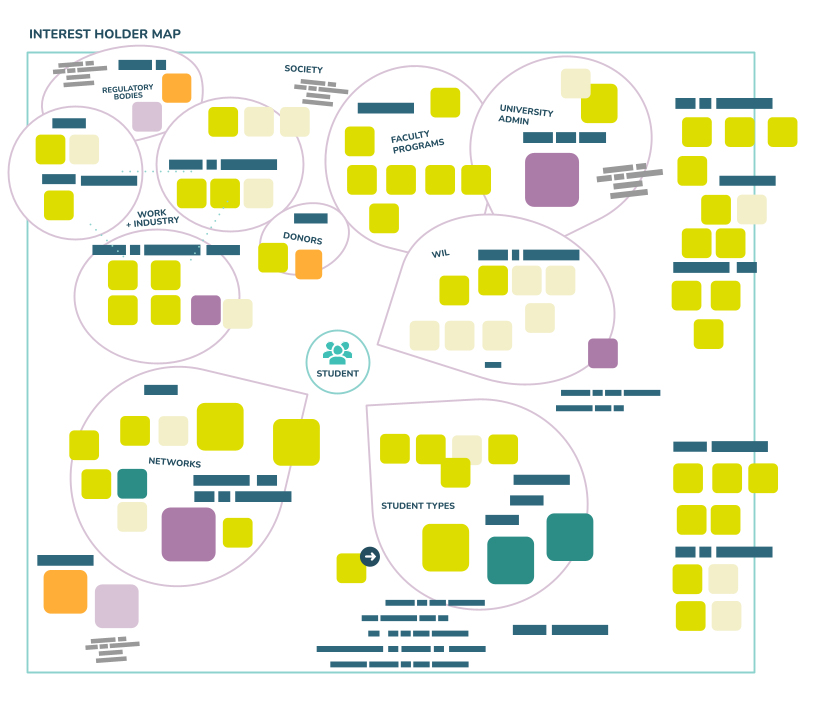
Next, we moved to an interest-holder mapping exercise, laying out all of the different groups with an interest in the outcome of the WIL ND project.
“Feedback from interest-holders guided the resource content and format, but most importantly, the thoughtful process fostered engagement and connected individuals across a large campus.”
— Erin Kaipainen, Director, Student Success and Operations
The Results
Onlea delivered a set of recommendations outlining a suggested approach to resource development for the legacy project.
Since the priorities and concerns of the wider group of interest holders were captured during the workshops, a smaller team was able to dive into developing the resource on a compressed timeline, confident that it would satisfy both the larger project team and its intended audience.
“Following the workshops, we continued to engage participants through the creation of the modules. As a result, we’re wrapping up the project knowing we’ve built trust and created buy-in with some key members of our community.”
— Erin Kaipainen, Director, Student Success and Operations
Onlea’s multimedia development team is continuing our work with UCalgary to support the creation of their WIL-ND legacy resources.